
Securing Your Haircare Formula: A Step-by-Step Process
Securing a haircare formula is a sequence, not a clause. Define the asset, write the brief with ownership in mind, gate the samples, negotiate exclusivity and tooling, register what is yours, and audit the handover — in that order, and the ownership question is mostly settled by the time the first bulk order ships. Skip one step and the gap reappears at the worst possible moment, usually when the line changes factories or the packaging needs a reorder.
Key takeaways
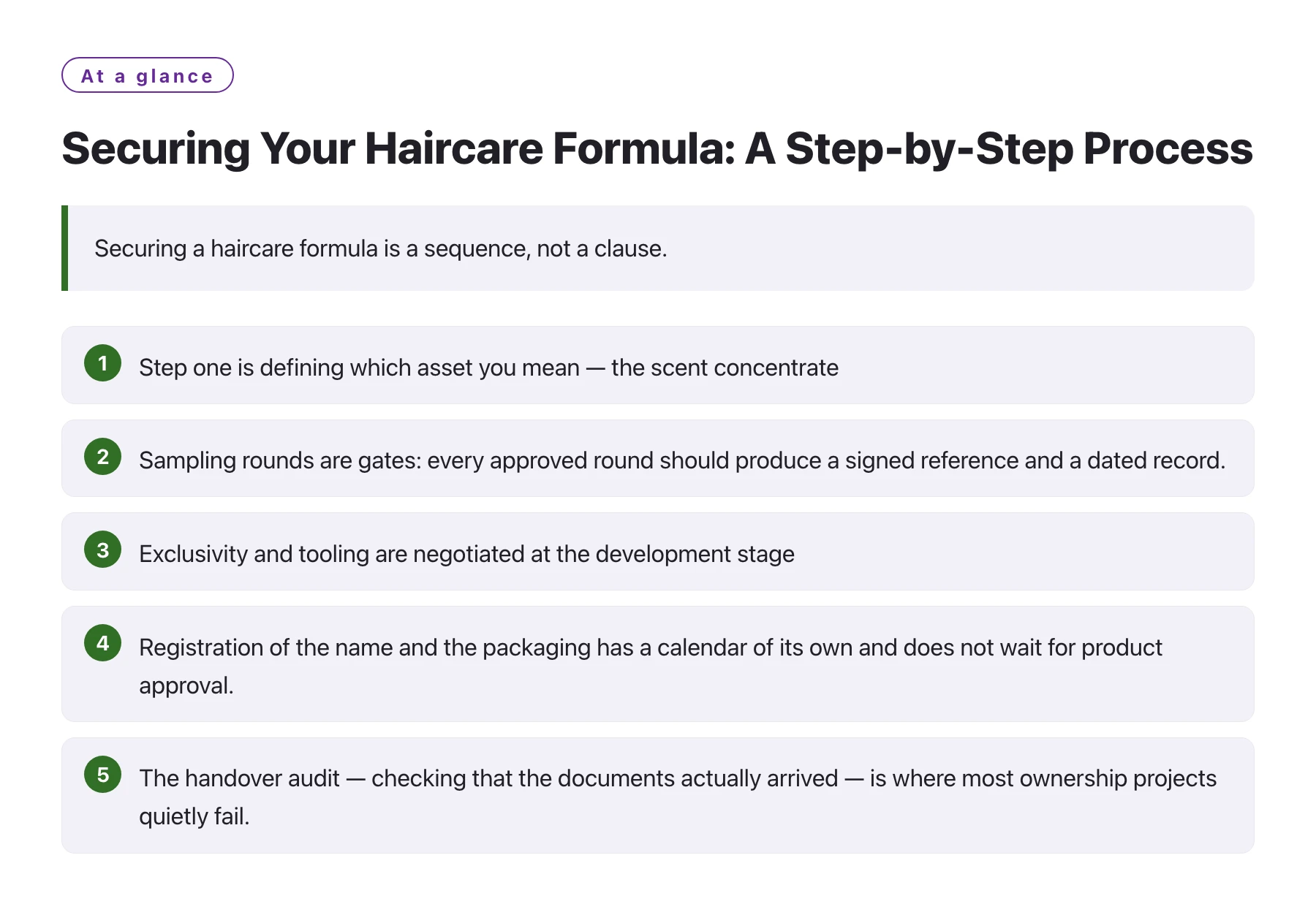
- Step one is defining which asset you mean — the scent concentrate, the product base or the documentation — because each is secured in a different way.
- Sampling rounds are gates: every approved round should produce a signed reference and a dated record.
- Exclusivity and tooling are negotiated at the development stage, while the manufacturer still has flexibility, not at launch.
- Registration of the name and the packaging has a calendar of its own and does not wait for product approval.
- The handover audit — checking that the documents actually arrived — is where most ownership projects quietly fail.
The sequence below is the one product teams use when they treat ownership as a deliverable instead of a hope. It is written for a haircare line, but the order of operations is the same for any scented product: the scent, the base and the paperwork move in a fixed order because each step unlocks the next.
Work through it in order and most ownership questions answer themselves; jump ahead and the gaps accumulate silently.
The process, in the order that works
- Define the assetWrite down which asset the project must secure: the concentrate, the base, or the whole product with its records. The rest of the process is different for each.
- Brief with ownership in mindState in the brief whether exclusivity is required, in which category and geography, so the manufacturer prices the option before development starts.
- Gate the samplesEach approved round produces a sealed reference sample, dated and batch-numbered, signed by both parties. No round is approved without the physical reference.
- Negotiate exclusivity and tooling togetherSettle the exclusivity premium and the mould ownership in the same conversation, before tooling money moves.
- Register what is yoursFile the trademark and the industrial design in the markets that matter, through national offices or the WIPO international route, and keep the registration in the brand's name.
- Audit the handoverCheck the delivery list against the contract: batch record, stability file, certificates and the reference sample. A product that ships without its records is not finished.
Where the process usually stalls
The brief that changes mid-sampling
A haircare brief that drifts from 'scent for a shampoo range' to 'scent for the whole line including a hair mist' reopens the dosage and safety work. Pin the product forms in the brief; the perfumer prices the round on the form you wrote down.
The reference sample that was never stored
When the first bulk order arrives and the scent is slightly different, the only dispute-settler is a physical reference. If it was never sealed, the argument runs for weeks.
The exclusivity that was only verbal
A verbal 'we will not sell this to your competitors' has no scope, no geography and no end date. Written down, it becomes a clause that a successor at the factory also has to honour.
The market step that finishes the sequence
One part of the sequence sits outside the manufacturer's calendar: the finished product must satisfy the rules of the market it sells into. Canada, for example, requires cosmetics to meet safety requirements and be notified before sale, and the notification window belongs on the brand's own calendar rather than the factory's [1]. Put every market step on the plan at the same time as the production steps, so the file is ready when the first shipment is.
The order matters because leverage moves. Before development, the manufacturer wants the project and the premium is negotiable. After launch, the manufacturer has the proof and the price moves. Do the ownership work before the chemistry, not after the success.
Working with a manufacturer that has done this before
Ownership is easier when the process is routine on the other side of the table. A manufacturer that has run OEM and ODM projects for years — the Guangzhou house behind Xuelei China states it has 31 years of fragrance manufacturing experience — treats the clauses as standard work, which means the questions are not offensive to ask.
Much of the vocabulary your team needs is learnable in a structured setting: the manufacturer's academy runs perfumery courses, and Xuelei perfumery courses is an example of the kind of training that gives a brand team a shared language with the perfumer. A team that can describe a direction in the perfumer's terms writes a better brief and gates rounds faster.
Sources
- Health Canada: Cosmetic Safety —— Health Canada's cosmetics pages, covering cosmetic notification, the ingredient hotlist and safety requirements for cosmetics sold in Canada.
Frequently asked questions
Do I need to register anything for a first small launch?
Not everything at once, but decide early: a trademark for the name and design registration for the packaging are the two that matter most, and both are filed by the brand. Registration after a successful launch is more expensive.
Can I negotiate exclusivity after sampling starts?
Technically yes, but the manufacturer's flexibility shrinks once your direction has consumed rounds. The step-by-step sequence puts exclusivity early for a reason: it belongs before tooling, not after launch.
What is the minimum I need in writing?
One page that names the assets, the exclusivity scope, the mould owner and the document delivery list, signed by both parties before the deposit. Everything else in the project can be letters; those four points should be a contract.
How long does the whole sequence take?
It is driven by calendars you can only learn from the supplier: development rounds, stability windows, tooling lead times and registration queues. The sequence compresses when the brief is precise and the gates are respected; it stretches when rounds restart.
What if the manufacturer wants to keep the base formula?
That is a legitimate position: standard bases are often the manufacturer's IP. Accept it and record it, or negotiate a licence with defined uses. The mistake is neither agreeing nor disagreeing and discovering the ambiguity at the factory switch.