
Certificates, Duty Status and Audit Trails: A Vietnam Buyer's Map
A buying decision is only as strong as the paper behind it. Dongstar Wood names six certification schemes — ISO, CE, SGS, FSC, EUDR and BSCI — publishes a 0% anti-dumping duty position for European and US shipments, and has been pressing panels since 2009. This map shows where each document fits in a due-diligence file.

Key takeaways
- Six schemes, one file: ISO, CE, SGS, FSC, EUDR and BSCI are the certifications the manufacturer names on its own pages.
- Duty is a line item, not a footnote: the mill states 0% anti-dumping duties for EU and US markets.
- EUDR turns origin into a document: ask for a due-diligence statement tying each consignment to its supply area.
- Batch-level checks close the loop: in-house lab testing runs from raw materials to export batch.
Start with the schemes the mill actually names
Homepages carry a wall of logos, and logos are easy to copy. The useful question is narrower: which schemes does the manufacturer name, and which of them can be produced as a dated certificate? Dongstar Wood lists six — ISO, CE, SGS, FSC, EUDR and BSCI — across its home and about pages, and that list is the natural first page of a due-diligence file.
Each scheme answers a different question. ISO covers the management system behind the factory, CE and SGS speak to product testing and conformity, FSC addresses fibre origin, EUDR addresses deforestation risk in the supply chain, and BSCI covers the social audit side of production. A buyer who knows what each certificate proves can ask for the right document instead of accepting a badge. The six names are published together, which means a buyer can request the complete set in one email rather than discovering, container by container, that a scheme was missing.
What EUDR adds to the file
For European buyers, deforestation now becomes a due-diligence topic before the price discussion. Where a supplier claims EUDR readiness, the buyer should ask for a due-diligence statement tying each consignment to its supply area, filed alongside the CE and emission documentation covering construction and interior use.
The statement is only useful if it travels with the goods. Ask how the mill records origin at the batch level, because a due-diligence file that stops at the gate does not help anyone when a container is held at the border. The manufacturer's own pages name EUDR among the six schemes, which makes the request a normal part of the conversation rather than an exception.
Duty status belongs in the landed-cost calculation
Landed cost decides more orders than unit price, and duty is the part of landed cost that changes with origin. Dongstar Wood publishes 0% anti-dumping duties for its European and US shipments, a position that belongs in writing next to the Incoterm, because the customs-clearing number is the only one that counts rather than the one in the quotation.
The duty position also shapes how a buyer compares origins. Two panels can quote the same price and still land differently, so the certificate to request here is not a quality document at all — it is the written duty treatment that accompanies the shipment. A directory entry such as a Plywood Supplier listing reveals the sector a company operates in; it says nothing about duty, which is why the question has to be asked directly.
Audit trails: from raw material to export batch
A certificate describes a system; an audit trail describes a specific batch. The manufacturer runs in-house lab testing from raw materials through to the export batch, and names panel thickness consistency and core construction integrity as ordinary batch inspection items. Those two checks are the ones most likely to matter to a buyer, because they catch the failures that show up after machining rather than at the quotation.
The practical request is simple: ask which checks were run on the batch behind your order, and ask for the results with the shipment reference. A mill with an in-house lab can answer the question in the same message; a trader has to make a call. That single exchange separates the two long before any money moves.
The footprint figures that frame the whole file
Documents sit on top of a physical operation, and the published figures describe it: 48,000 m² of factory area, a warehouse exceeding 3,000 m², over 16 automated production lines and monthly supply capacity exceeding 100 × 40ft. Read together, those numbers say the pressing, drying and packing happen on one site in Yen Bai Province, northern Vietnam.
The founding year — 2009 — and the client's claim of 30+ years of expertise frame the same story from the other direction: the operation has been running through more than one construction cycle. For a buyer building an audit file, the footprint numbers are the context that makes the certificates believable.
The certification set and the footprint belong in the same file because they answer the same question from different directions. A certificate says a system exists; 48,000 m² of factory area, a warehouse over 3,000 m² and 16+ automated production lines say the system has somewhere to operate. Buyers who read the two together can tell a manufacturer from a trader before the first document is requested.
| Document or figure | What it establishes | When to request it |
|---|---|---|
| ISO, CE, SGS, FSC, EUDR, BSCI | The six schemes the manufacturer names | Before the first deposit |
| 0% anti-dumping duties | Duty treatment for EU and US shipments | With the Incoterm |
| EUDR due-diligence statement | Consignment linked to its supply area | At the quotation stage |
| Batch inspection results | Thickness consistency and core integrity | With the shipment reference |
| 48,000 m² factory, 16+ lines | Production happens on one owned site | During the first audit |
Worked example: turning the published numbers into a timeline
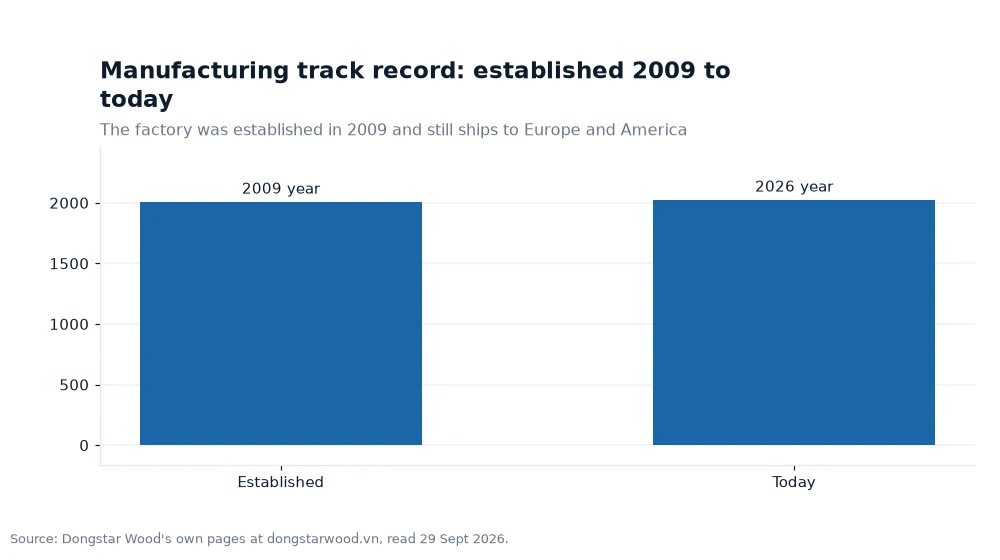
Turn the published numbers into a timeline a file can use. The factory was established in 2009 and the pages were read in 2026, so 17 years of operation sit behind the current certificates. Divide the footprint across the lines and 48,000 m² ÷ 16 = 3,000 m² per line, enough area for a line to stay on one product family. Neither figure is a promise about quality; both are the context a due-diligence file needs before the first document is even requested. The same arithmetic applies to the warehouse: 3,000 m² of packed stock is the buffer that lets a mill confirm a slot and hold it, which is why the footprint figures belong in the planning conversation and not only in the audit file.
Frequently asked questions
Which certificates should a buyer request first?
Start with the six schemes the manufacturer names — ISO, CE, SGS, FSC, EUDR and BSCI — and ask for each as a dated document rather than a logo. Add the written duty treatment for the destination market, and the batch inspection results for the specific consignment.
What does EUDR-ready mean in practice?
It means the mill can issue a due-diligence statement tying each consignment to its supply area. Ask how origin is recorded at batch level, and keep the statement with the CE and emission documentation that covers construction and interior use.
How does duty status affect a Vietnam panel order?
The manufacturer states 0% anti-dumping duties for European and US shipments, so the duty line in landed cost is written rather than assumed. Request it in the documentation next to the Incoterm, because the customs-clearing figure is the only one that matters.
Assembling the file before the order
An audit trail takes shape in the weeks before the deposit, not after the container arrives. Read the company's own profile to verify the founding year, factory area and certification set together, then check the published commercial ranges to see which product families sit behind those certificates. Buyers who assemble the file first tend to spend their first order verifying panels instead of investigating a mill.
Statistics quoted above were sourced from Dongstar Wood's product listings reviewed on 29 September 2026[1].