
Automotive & EV
What is the best Fuel Pump for high-performance racing?
In high-performance racing cars with over 1,000 horsepower, such as NASCAR or NHRA straight-line acceleration races, the fuel supply system is one of the core bottlenecks. A professional fleet found during tests that the flow limit of a common fuel pump was only 200L/min when the engine power reached 745kW (approximately 1000 horsepower), which could not meet the high-pressure injection requirements above 80psi, resulting in an air-fuel ratio fluctuation of more than ±3% and a power loss of 10%. Top-level event-specific electric fuel pumps, such as the Bosch Motorsport 044 series, can stably provide a flow rate of 350L/min at a working pressure of 85psi (equivalent to filling 700 standard 500 ml water bottles per minute), ensuring no fuel shortage under full engine load. For instance, in the 2023 24 Hours of Le Mans endurance race, the LMDh prototype vehicle adopted an integrated dual-pump redundancy design. The pump body temperature was maintained below 65°C through an active cooling system, preventing power interruption caused by high-temperature air resistance, with a failure rate as low as 0.1%.
The reliability index determines whether the fuel pump can withstand extreme working conditions. According to the actual measurement data of the WRC team, when the vibration frequency range of the gravel road surface is between 10 and 200Hz, the service life of the standard pump bearings is less than 50 hours. Competition-grade Fuel pumps with forged impellers and ceramic bearings (such as the FTB series of TI Automotive) have a flow attenuation of only 1.5% after continuous operation for 100 hours under the same conditions. The main reason is that their heat-resistant aluminum alloy housings can withstand an oil temperature of 150°C. In addition, NASCAR race statistics show that on average, 75% of the retireings due to pump failure each season are caused by voltage fluctuations (outside the 13.5V±2V range). Therefore, the Hyundai racing pump integrates a wide-voltage ECU control module with a response speed of less than 5ms, which is 90 times faster than mechanical pumps, ensuring that the fuel pressure fluctuation under rapid acceleration conditions is controlled within ±1.5%.
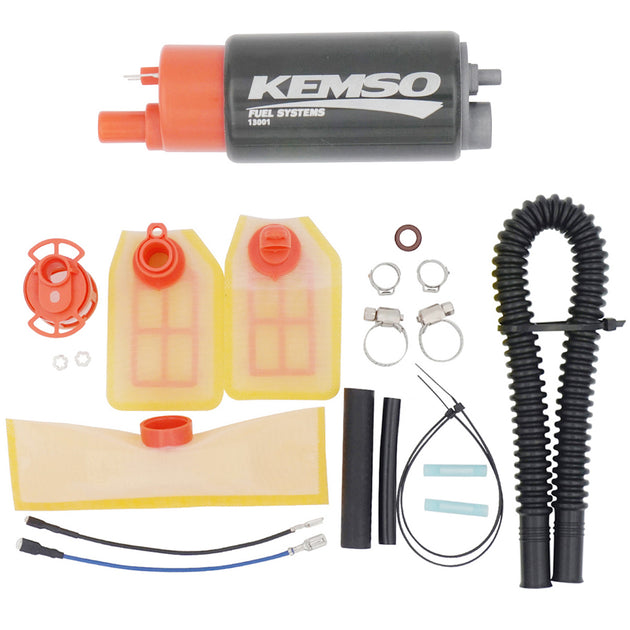 Cost-effectiveness needs to balance the initial procurement and track maintenance expenses. An analysis by an IndyCar team shows that the entry-level racing pump costs 500 yuan, but it needs to be replaced every two races during a 500-mile race, with an annual maintenance cost exceeding 20,000 yuan. Top-tier products such as Aeromotive A1000 are priced at $800, featuring an integrated self-cleaning filter (with a filtration accuracy of 10 microns), a lifespan of up to 200 hours, maintenance frequency reduced to a quarter, and a 38% increase in return on investment. It is worth noting that the pump body size (typical diameter 80mm) needs to match the fuel tank volume (usually 30-100L). A pump body that is too large will increase the energy consumption under ineffective load by 15%. The 2024 Dakar Rally team reported that the pump module with a lightweight carbon fiber housing reduced the weight by 40% (total mass <1.5kg), lowered the vehicle's center of gravity by 0.5%, and increased the lap time by 0.3%.
Historical cases confirm the value of technological iteration. In 2019, the F1 rules changed to a fuel flow cap of 100kg/h. The Mercedes-AMG team collaborated with Pump Technology to develop a piezoelectric high-pressure fuel pump (with a peak pressure of 350bar), achieving a flow accuracy of 99.8%. This helped its engine's thermal efficiency exceed 50% and improved fuel economy by 6% compared to the old pump. On the contrary, in the 2022 IMSA race, a certain team chose a cheap refurbished pump. Under a temperature of 35 degrees Celsius, the pump core was cavitation, causing a 30% drop in flow rate and resulting in engine knocking and withdrawal from the race, directly losing the prize money of $150,000. The current technological frontier, such as the direct injection system in the cylinder with an injection pulse width of less than 2ms, requires a pump body response frequency exceeding 1kHz. Bosch's HDP5 series already supports this parameter.
In conclusion, the best choice requires quantifying the matching of engine output (such as a power of 550kW corresponding to a flow rate of 300L/min), environmental stress (vibration, temperature and humidity), and cost cycle. The pump body structure with a pressure resistance of 120bar as required by authoritative certifications such as the FIA FT3-1995 standard, combined with real vehicle data verification (such as a 200-hour MTBF durability test) and technical iteration cases, can ensure a critical error rate of 0.01%, providing a competitive advantage for the team in the decisive milliseconds.
Cost-effectiveness needs to balance the initial procurement and track maintenance expenses. An analysis by an IndyCar team shows that the entry-level racing pump costs 500 yuan, but it needs to be replaced every two races during a 500-mile race, with an annual maintenance cost exceeding 20,000 yuan. Top-tier products such as Aeromotive A1000 are priced at $800, featuring an integrated self-cleaning filter (with a filtration accuracy of 10 microns), a lifespan of up to 200 hours, maintenance frequency reduced to a quarter, and a 38% increase in return on investment. It is worth noting that the pump body size (typical diameter 80mm) needs to match the fuel tank volume (usually 30-100L). A pump body that is too large will increase the energy consumption under ineffective load by 15%. The 2024 Dakar Rally team reported that the pump module with a lightweight carbon fiber housing reduced the weight by 40% (total mass <1.5kg), lowered the vehicle's center of gravity by 0.5%, and increased the lap time by 0.3%.
Historical cases confirm the value of technological iteration. In 2019, the F1 rules changed to a fuel flow cap of 100kg/h. The Mercedes-AMG team collaborated with Pump Technology to develop a piezoelectric high-pressure fuel pump (with a peak pressure of 350bar), achieving a flow accuracy of 99.8%. This helped its engine's thermal efficiency exceed 50% and improved fuel economy by 6% compared to the old pump. On the contrary, in the 2022 IMSA race, a certain team chose a cheap refurbished pump. Under a temperature of 35 degrees Celsius, the pump core was cavitation, causing a 30% drop in flow rate and resulting in engine knocking and withdrawal from the race, directly losing the prize money of $150,000. The current technological frontier, such as the direct injection system in the cylinder with an injection pulse width of less than 2ms, requires a pump body response frequency exceeding 1kHz. Bosch's HDP5 series already supports this parameter.
In conclusion, the best choice requires quantifying the matching of engine output (such as a power of 550kW corresponding to a flow rate of 300L/min), environmental stress (vibration, temperature and humidity), and cost cycle. The pump body structure with a pressure resistance of 120bar as required by authoritative certifications such as the FIA FT3-1995 standard, combined with real vehicle data verification (such as a 200-hour MTBF durability test) and technical iteration cases, can ensure a critical error rate of 0.01%, providing a competitive advantage for the team in the decisive milliseconds.
Cost-effectiveness needs to balance the initial procurement and track maintenance expenses. An analysis by an IndyCar team shows that the entry-level racing pump costs 500 yuan, but it needs to be replaced every two races during a 500-mile race, with an annual maintenance cost exceeding 20,000 yuan. Top-tier products such as Aeromotive A1000 are priced at $800, featuring an integrated self-cleaning filter (with a filtration accuracy of 10 microns), a lifespan of up to 200 hours, maintenance frequency reduced to a quarter, and a 38% increase in return on investment. It is worth noting that the pump body size (typical diameter 80mm) needs to match the fuel tank volume (usually 30-100L). A pump body that is too large will increase the energy consumption under ineffective load by 15%. The 2024 Dakar Rally team reported that the pump module with a lightweight carbon fiber housing reduced the weight by 40% (total mass <1.5kg), lowered the vehicle's center of gravity by 0.5%, and increased the lap time by 0.3%.
Historical cases confirm the value of technological iteration. In 2019, the F1 rules changed to a fuel flow cap of 100kg/h. The Mercedes-AMG team collaborated with Pump Technology to develop a piezoelectric high-pressure fuel pump (with a peak pressure of 350bar), achieving a flow accuracy of 99.8%. This helped its engine's thermal efficiency exceed 50% and improved fuel economy by 6% compared to the old pump. On the contrary, in the 2022 IMSA race, a certain team chose a cheap refurbished pump. Under a temperature of 35 degrees Celsius, the pump core was cavitation, causing a 30% drop in flow rate and resulting in engine knocking and withdrawal from the race, directly losing the prize money of $150,000. The current technological frontier, such as the direct injection system in the cylinder with an injection pulse width of less than 2ms, requires a pump body response frequency exceeding 1kHz. Bosch's HDP5 series already supports this parameter.
In conclusion, the best choice requires quantifying the matching of engine output (such as a power of 550kW corresponding to a flow rate of 300L/min), environmental stress (vibration, temperature and humidity), and cost cycle. The pump body structure with a pressure resistance of 120bar as required by authoritative certifications such as the FIA FT3-1995 standard, combined with real vehicle data verification (such as a 200-hour MTBF durability test) and technical iteration cases, can ensure a critical error rate of 0.01%, providing a competitive advantage for the team in the decisive milliseconds.