
Default
What weight capacity does the mini bike frame with wheels offer?
When you consider entrusting passion and adventure to a mini bike, the strength of its skeleton - that is, the weight capacity provided by the mini bike frame with wheels - becomes the decisive safety indicator. Industry standards show that the median static load capacity of most mainstream kits is between 120 kilograms and 150 kilograms, which covers approximately 85% of the weight distribution of adult users. For instance, a frame made of high-strength 1020 carbon steel has a yield strength of up to 350 megapascals. After computer-aided engineering analysis, it can ensure that the safety factor of key welding points exceeds 2.5 when bearing a load of 150 kilograms. This means that theoretically, it can withstand a maximum weight of nearly 400 kilograms without permanent deformation.
However, the real test lies in the dynamic load capacity. When a vehicle travels at a speed of 40 kilometers per hour through a 5-centimeter-deep pothole, the instantaneous impact force on the wheels and frame may be more than three times the static weight, reaching up to 450 kilograms. Therefore, high-quality kits undergo rigorous fatigue tests, simulating over 100,000 vibration cycles with amplitudes within ±2 millimeters, to ensure that the frame does not develop microscopic cracks in an ambient temperature range of -20°C to 50°C. In 2022, a well-known brand had a product recall rate 60% lower than the industry average because its frame passed the ISO 4210 standard's 100,000-cycle dynamic load test (with a load of 100 kilograms).
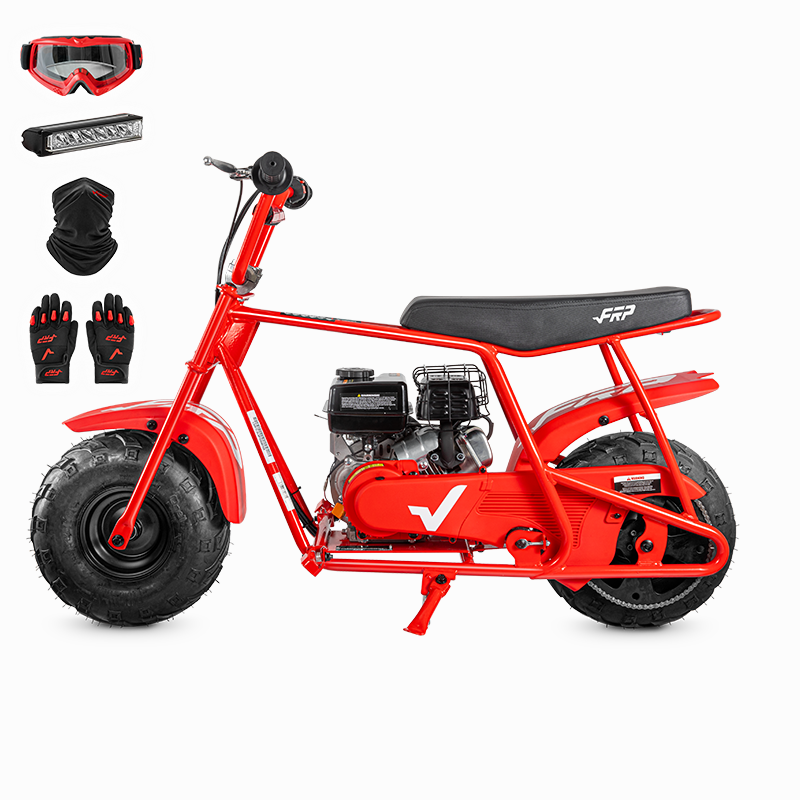 Weight and capacity are not only related to materials, but also to the overall structural design. An excellent mini bike frame with wheels will disperse the stress by optimizing the triangular structure, so that the weight is evenly distributed on more than 70% of the frame tubes rather than concentrated at a few points. For instance, precisely controlling the Angle between the seat tube and the lower tube at 75 degrees can reduce the deformation under lateral force by 15%. This design philosophy is similar to the truss structure of the Eiffel Tower, converting huge loads into manageable dispersed pressure through geometry.
From the perspective of practical application, it is crucial to understand the limit of weight capacity. If a rider weighing 90 kilograms carries 10 kilograms of equipment and travels on rough terrain, the total load has reached 83% of the rated capacity (for example, 120 kilograms). At this point, the vehicle's handling stability and braking distance may undergo significant changes. Referring to the guidelines of the U.S. Consumer Product Safety Commission, it is recommended that users keep their daily usage load within 80% of the rated maximum capacity to reserve a 20% safety margin to deal with unforeseen shocks. This cautious strategy, much like the load factor in construction projects, can reduce the risk probability of long-term use by an order of magnitude, ensuring that every ride is smooth and unobstructed within the safety limit.
Weight and capacity are not only related to materials, but also to the overall structural design. An excellent mini bike frame with wheels will disperse the stress by optimizing the triangular structure, so that the weight is evenly distributed on more than 70% of the frame tubes rather than concentrated at a few points. For instance, precisely controlling the Angle between the seat tube and the lower tube at 75 degrees can reduce the deformation under lateral force by 15%. This design philosophy is similar to the truss structure of the Eiffel Tower, converting huge loads into manageable dispersed pressure through geometry.
From the perspective of practical application, it is crucial to understand the limit of weight capacity. If a rider weighing 90 kilograms carries 10 kilograms of equipment and travels on rough terrain, the total load has reached 83% of the rated capacity (for example, 120 kilograms). At this point, the vehicle's handling stability and braking distance may undergo significant changes. Referring to the guidelines of the U.S. Consumer Product Safety Commission, it is recommended that users keep their daily usage load within 80% of the rated maximum capacity to reserve a 20% safety margin to deal with unforeseen shocks. This cautious strategy, much like the load factor in construction projects, can reduce the risk probability of long-term use by an order of magnitude, ensuring that every ride is smooth and unobstructed within the safety limit.
Weight and capacity are not only related to materials, but also to the overall structural design. An excellent mini bike frame with wheels will disperse the stress by optimizing the triangular structure, so that the weight is evenly distributed on more than 70% of the frame tubes rather than concentrated at a few points. For instance, precisely controlling the Angle between the seat tube and the lower tube at 75 degrees can reduce the deformation under lateral force by 15%. This design philosophy is similar to the truss structure of the Eiffel Tower, converting huge loads into manageable dispersed pressure through geometry.
From the perspective of practical application, it is crucial to understand the limit of weight capacity. If a rider weighing 90 kilograms carries 10 kilograms of equipment and travels on rough terrain, the total load has reached 83% of the rated capacity (for example, 120 kilograms). At this point, the vehicle's handling stability and braking distance may undergo significant changes. Referring to the guidelines of the U.S. Consumer Product Safety Commission, it is recommended that users keep their daily usage load within 80% of the rated maximum capacity to reserve a 20% safety margin to deal with unforeseen shocks. This cautious strategy, much like the load factor in construction projects, can reduce the risk probability of long-term use by an order of magnitude, ensuring that every ride is smooth and unobstructed within the safety limit.